
Trusst: Content Module
Role: UX Design & Research
Tools: Figma, Principle
Background
Project summary
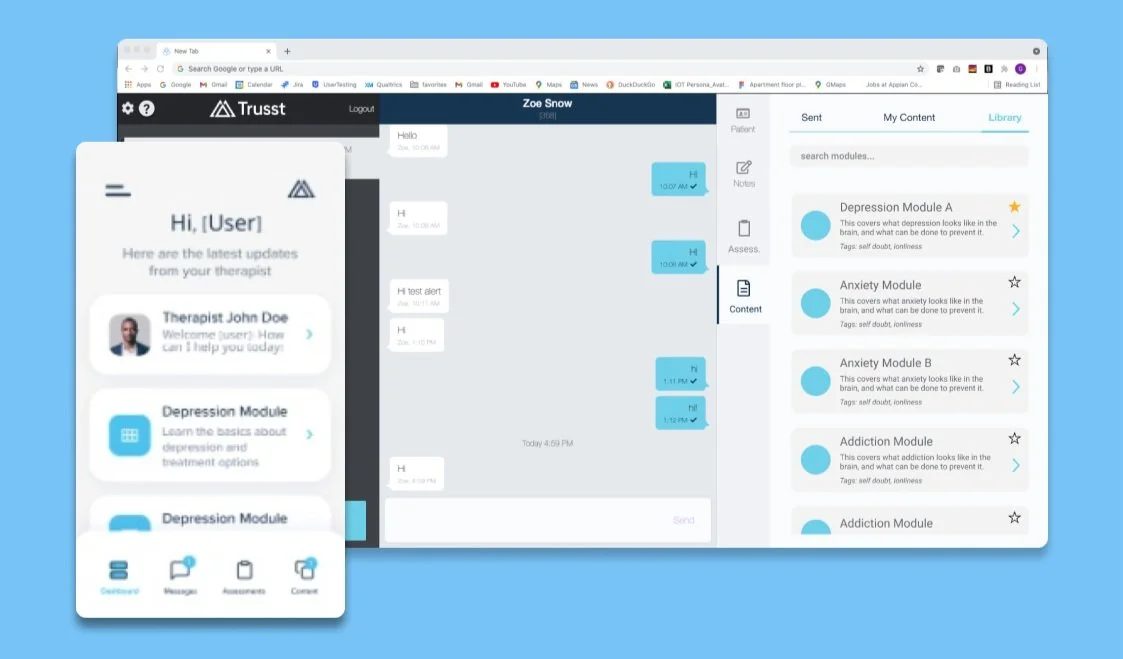
We identified clients’ need for more touchpoints with their therapists between sessions. We developed the ability for therapists to send modules to their clients.
The solution added an opportunity for clients to work towards their mental health goals without over-taxing their therapists.
About Trusst
Trusst is a mental healthcare app with the mission of making quality therapists affordable and accessible to students. The startup is motivated to help therapists succeed professionally; a dashboard enables affiliated therapists to take on clients by streamlining client management and communications online.

Discovery
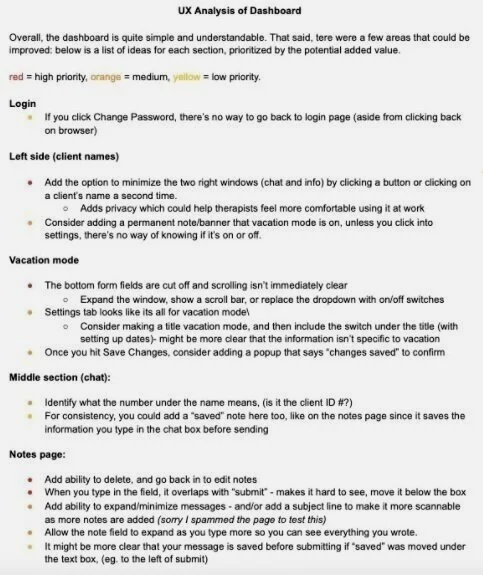
A heuristic analysis of the app and dashboard to identify and prioritize opportunities for improvement.
Two themes for improvement were:
Allow users to undo/go back
Edit icons/labels for clarity
I drafted a research brief for user interviews and met with the Product Manager to ensure my moderated test script aligned with Trusst’s business goals.
Four therapists and five clients participated in the 45-minute 1:1 feedback sessions.
Personas
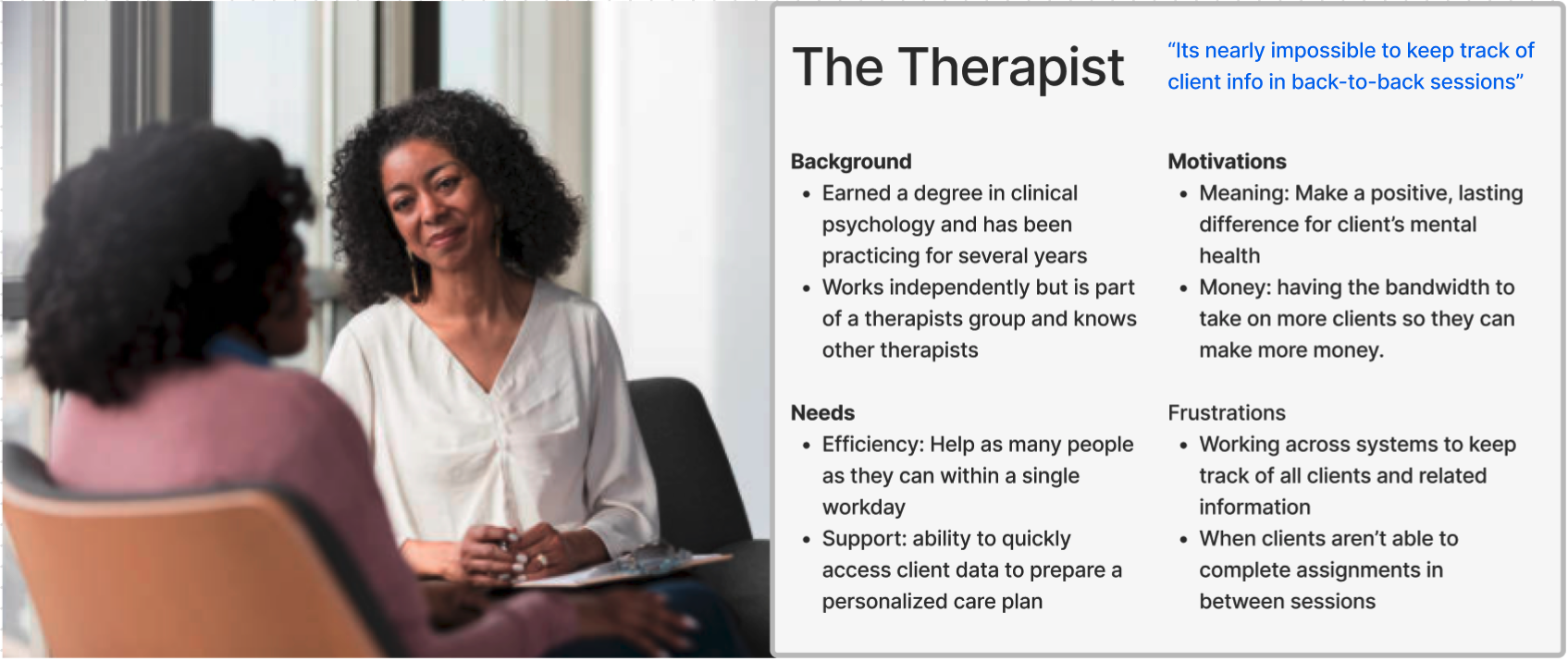
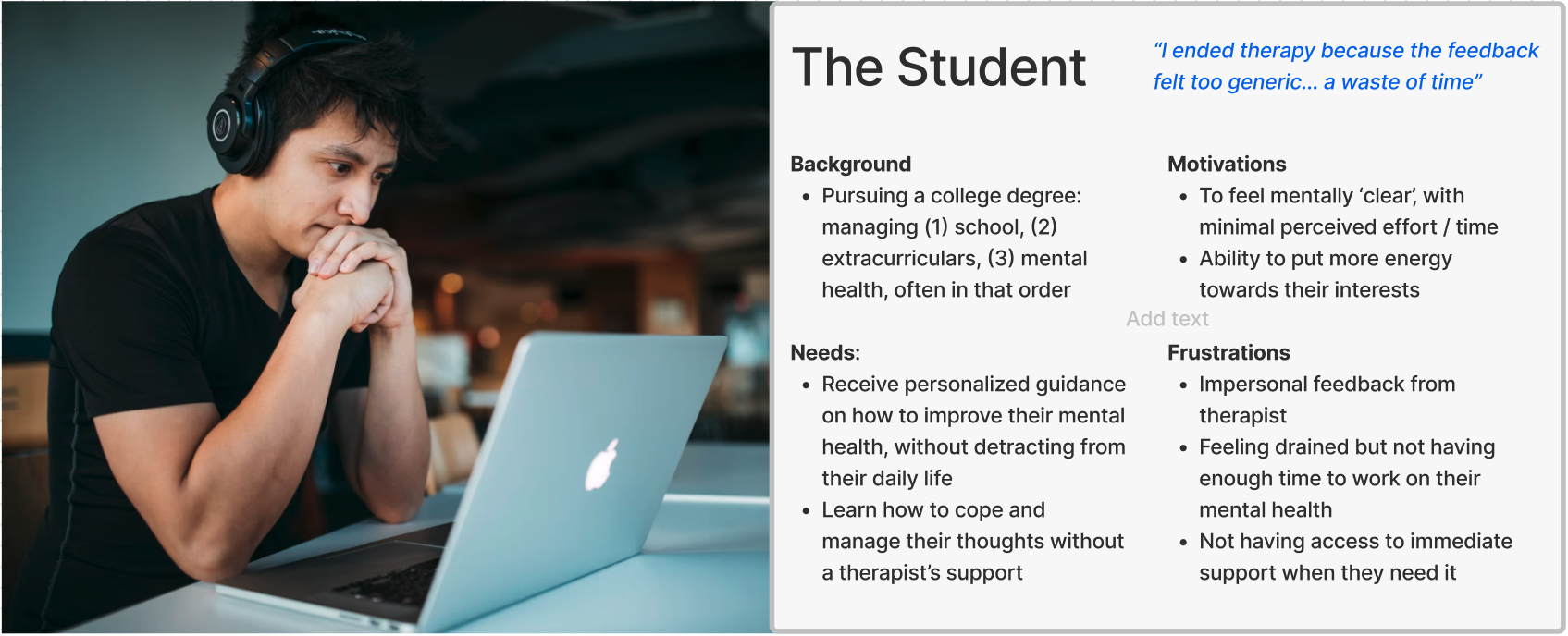
Conversations with clients and clinicians informed the personas for both user groups.
Overall, clinicians were motivated by making a positive difference for as many clients as possible but required efficient, effective communication to accomplish that goal.
Clients were motivated to prevent mental health from sidetracking their daily lives but were occasionally dissatisfied with the support they received from their Trusst therapist.
A Solution
Content Modules: mental health tips & exercises that therapists can assign to their clients in between therapy sessions.
Content modules would allow therapists to assign personalized modules to help the client better understand and work on their mental health on their own schedule (via the Trusst App).
Problem
Relying on instant messaging was limiting for clients and therapists because mental health fluctuations don’t occur on a schedule.
For therapists, the instant messaging format pressured them to be available to speak with any given client on short notice. Because therapists cannot offer 24/7 availability, clients were often left without support in times when they needed it most.
Feature Specification
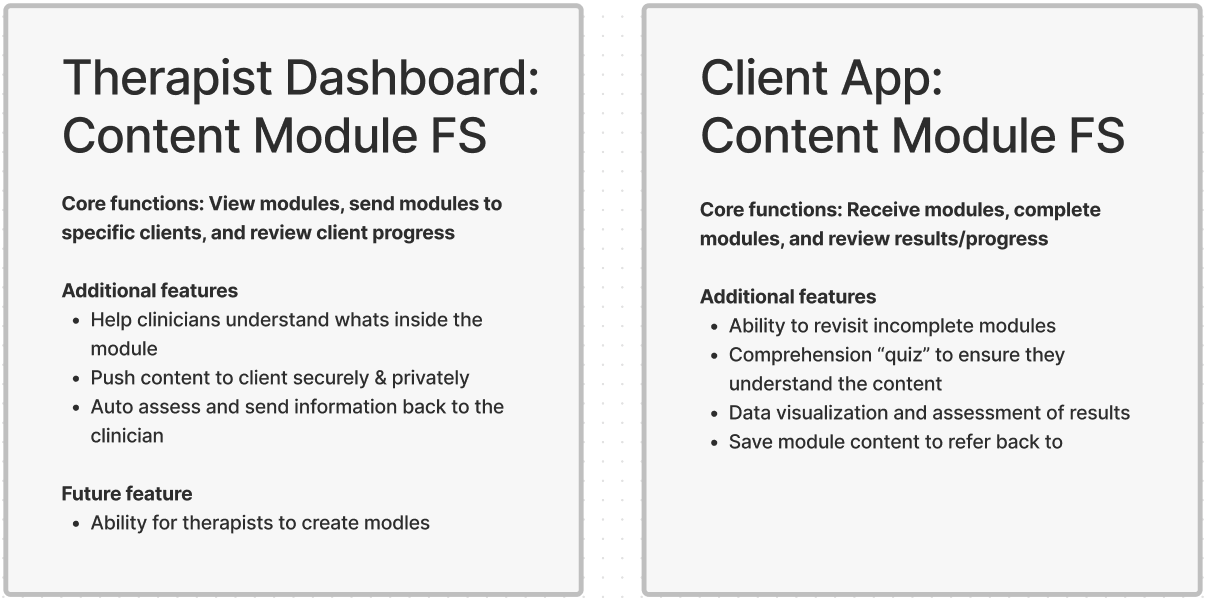
After discussing the potential approaches for the content module with the Product Manager, we created a list of features/functions to guide the content module design process.
Sketching
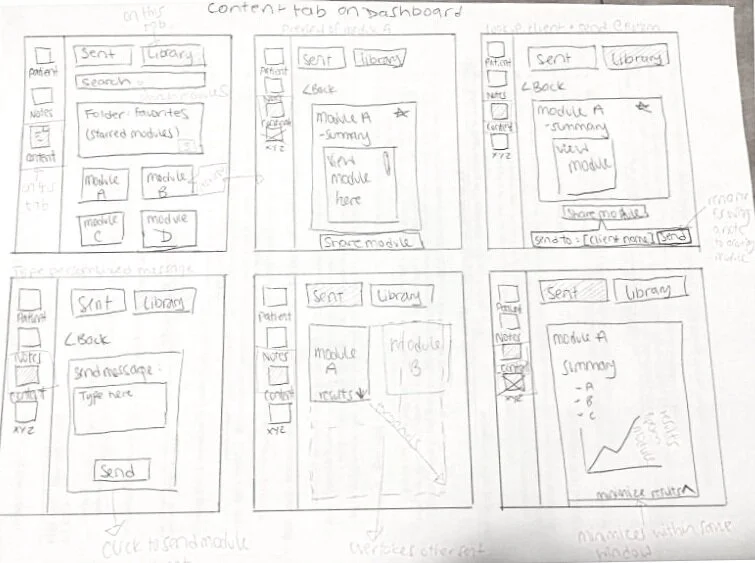
I developed a user scenario to inform the flow of the client/therapist interfaces
User scenario: Therapist
Log on to Trusst from desktop
Navigate to Assessments tab
Click Library
Browse modules, select one to preview
Select the module or return to the library
Once a module is selected, Click send [module sent to client app]
View sent modules in the Assessments tab
Expand sent modules to review a client’s performance
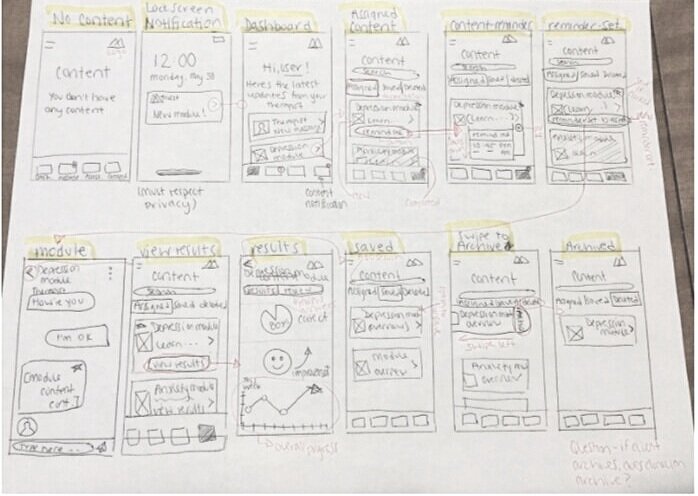
User scenario: Client
Receive notification: A module has been assigned
Secure log into Trusst app
View assigned module
Preview module and decide to do now, or set a reminder
Begin module (with option to pause and set a reminder)
Complete module and review results
Star/save content to personal library
Return to Trusst app to review content from completed modules
Wireframes
Next, I mocked up wireframes for the dashboard and app to review with the engineers. We decided the following adjustments were necessary to reach a feasible MVP.
Once we reached alignment on what was possible, I conducted RITE user testing sessions before moving onto the final phase of hi-fidelity designs.
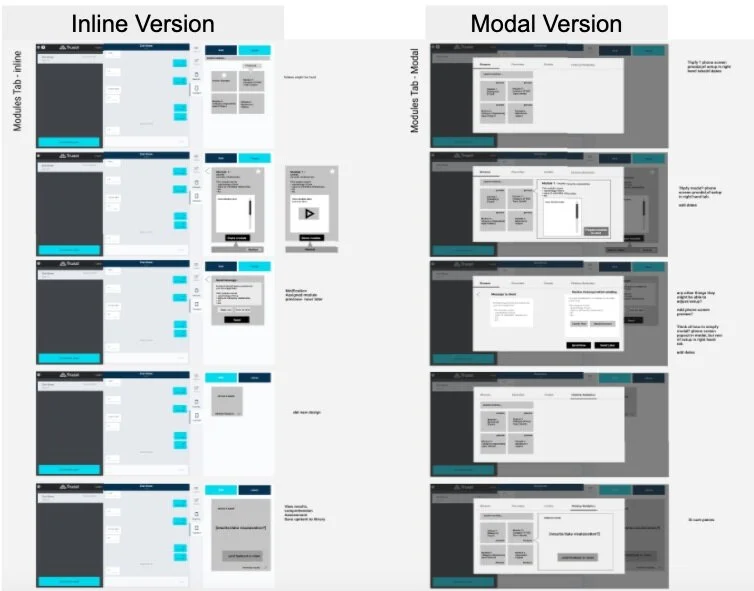
Changes to the final dashboard prototype based on stakeholder & user feedback:
Changes based on user needs:
Added a ‘save modules’ tab to enable clinicians to build a library of modules to refer to
To fit more text and make the design more linear, modules were elongated to become rectangles (rather than squares)
‘Completed’ receipts were added to assigned modules to help clinicians track progress from clients
Changes based on MVP constraints:
Pursued the in-line version because it was more feasible to build
Omitted the ability to sort modules into folders because there weren’t enough modules to require sorting at that point
Module results moved to a new page (rather than in a dropdown)
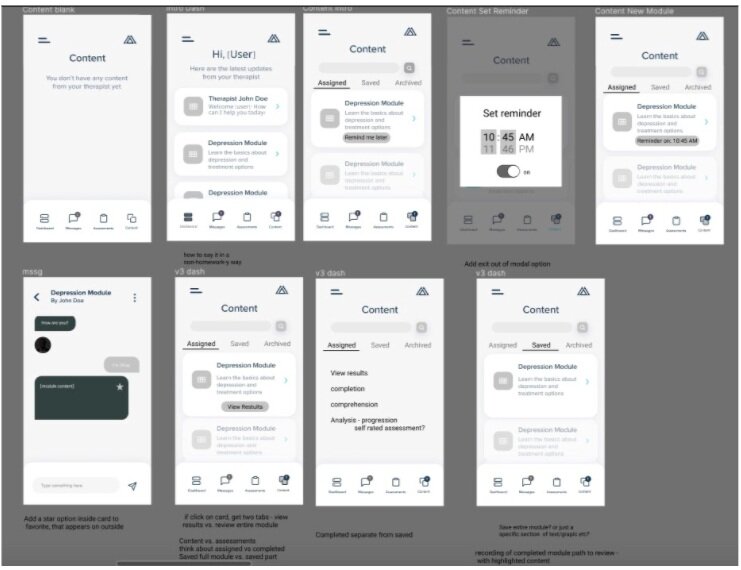
Changes for the final app prototype:
Omitted the option to save specific content within a module. Instead, clients could save the whole module (or none of it).
Added the ability to set a date for the reminder (in addition to time)
Added progress bar to the incomplete modules
Mocked up a results data visualization screen
Designed a secure mobile notification
Final design
Finally, I applied the style guide to the greyscale prototype and added click-through hotspots as handoff for the Trusst stakeholders.
Note: Link to prototype could not be shared for NDA reasons
Desktop dashboard, for therapists:
Mobile app, for clients:
Reflection
Insight from the project: it’s important to design for users as well as the software developers building the product
The hardest part: iterating without a whiteboard. In the future, I would spend more time iterating to the design in a quick, low-fidelity medium to explore alternative solutions.
Next steps: Handoff to Product Manager and Developers for implementation
Related project: Concurrent with this project, I analyzed user data to understand how long and how frequently clients interact with the app in order to provide feedback on how we might boost user engagement